Monday, May 13, 2019

About discipline, bullying and love to your children

This is what happened today in my daughter's gymnastics class: at first, this boy who was taller suddenly climbed on my daughter who just had a flip on the mat and lying down face up. I didn't react, he was on top of her for around 10 seconds, I waited out. It was just a children's play to me. My daughter complained that her leg got a little hurt, I said: "it's ok, he was just playing with you, giving you a hug."

20 minutes later my daughter was walking on the balance beam by herself, the same boy suddenly came from behind and pushed her hard, knocked her down to the ground. I raised my voice on him:"NO!" "No pushing!""Please say sorry to her."

And I realized it later that the boy actually identified my daughter as a "weak" one because when he did his first try of bullying, I didn't react. My daughter is tough, she also didn't care much. Even when she was knocked down from the balance beam, she didn't react a bit, only watching my response. 

And yes, I have zero tolerance for bullying, because I face severe bullying and personal attack constantly. Also when I was 13 I was sexually assaulted/harassed/bullied, that affected me more than a decade of my young adulthood. So if you crossed my line, I will make sure my words are one of the strongest you will hear for a while.

Especially those budding bulliers, people need to have your firm "No"s for them to hear. For the ones their parents don't give enough disciplines at home, you are actually helping them by letting them know there are "No"s in this world. The earlier they realize the wrongs in their behavior, the less chance they end up in bad places.

And why I have to say "No" and demand a "sorry" from him right then and there? It is for the bullied side to see. So they know there is justice in the world. For kids this young, it is helping them to understand what is right and what is wrong. If nobody is there to serve justice, they will be confused. And if this frequently happens, they wouldn't be able to tell wrong from right.

There is an old Chinese saying "in the behavior of a three-year-old kid, you can see a picture of his/her adulthood."(三岁看长) Which means -- YOU GOT TO discipline your kids from at least 2-year-old. 2 to 6 years is the window, earlier than 2, he/she wouldn't understand, older than 6, you don't have the power anymore. The foundation of personality is mature at 6 and will last for a lifetime.

Teach them to respect, to share, to love, to have self-control, to conquer his/her selfishness. Teach them what is wrong and what is right, be firm with where your stand, no is no.

Each kid is beautiful but deep down in human nature if there was too much indulgence of unwatched love, greed and selfishness will grow with no time, and that will surely lead to the kid's unhappiness at the end.

Thursday, January 31, 2019

It's not easy for Indo-Chinese Couples? 嫁给印度人之来自中国的印度媳妇的心得


From Indians-In-China IICofficial 2018-08-14


"Raj and I fell in love within a few days after meeting each other at "Coffee Hour" at the beginning of our summer session in 2008. When we decided to get married in the year 2009, we didn't tell our parents because both sides wouldn't agree, and in fact, they were against our union at that time. So we got married at the Civic Center of San Francisco. After several years we finally gained approval from our families. In January 2013 my parents hosted a Chinese wedding ceremony for us in my hometown, a remote place in the mountain area in Fu Jian province. “

拉斯和我在2008年夏季会议开始时在”咖啡时刻“相遇后的几天内坠入爱河。当我们决定在2009年结婚时,我们没有告诉我们的父母,因为双方父母都是不同意的。所以我们在旧金山市政中心结婚。几年后我们终于得到了家人的认可。2013年1月,我的父母为我们举办了一个中国的婚礼仪式,我的家乡福建省山区偏远的地方。


As for Raj's family, they are going to host the Indian wedding in December 2013 in their hometown in east India. In Chinese and Indian society, wedding is one of the biggest social events, it's not only the bonding of two people, but more a family event. And since both of our parents need to host the wedding among their own social circles, there should be two ceremonies. So this is why we already had a Chinese wedding at the beginning of the year, and we are going to have an Indian wedding at the end of the year..."

至于Raj的家人,他们将于2013年12月在印度东部的家乡举办印度婚礼。在中国和印度社会,婚礼是最大的社交活动之一,它不仅是两个人的联系,更是一个家庭活动。由于我们的父母都需要在他们自己的社交圈中举办婚礼,所以应该有两个仪式。所以这就是为什么我们年初已经举办过中式婚礼,我们将在年底举办一场印度婚礼......“


Growing up, Zheng Momo from Guangze county, Fujian Province never imagined that she would marry a man from India, a nation that is geographically close China but still remains a mystery to most of China's population.

我来自福建省光泽县的郑墨沫从未想到她会嫁给一个来自印度的男人,印度是一个地理位置接近中国的国家,但对中国大多数人口来说仍然是一个谜。

She and Raj Shekhar Singh, from Bokaro in India, have been married for 9 years, and live in the US.

来自印度Bokaro的她和Raj Shekhar Singh已经结婚9年了,住在美国。

"What attracts me to him is his rich spiritual world, his respect for women and his mercy to people and animals," Zheng said. “

吸引我的是他丰富的精神世界,他对女性的尊重以及对人和动物的怜悯,”郑说。

"We went through a lot of barriers to be with each other like most other people in China-India cross-cultural relationships. We really cherish what we have today."

“与中印跨文化关系中的大多数其他人一样,我们遇到了很多障碍。我们非常珍惜今天的生活。”

The number of China-India cross-cultural relationships and marriages has increased in recent years because of the more frequent economic and cultural exchanges between the two countries, according to Zheng's observations.

根据郑的观察,由于两国经济和文化交流日益频繁,近年来中印跨文化关系和婚姻的数量有所增加。

Hu Zhiyong, a research fellow at the Institute of International Relations of the Shanghai Academy of Social Sciences, also observed the same trend.

上海社会科学院国际关系研究所研究员胡志勇也观察到了同样的趋势。

"As the internationalization got deeper and the economic and trade relationships between China and Southeast Asian countries develop, China-India cross-cultural relationships and marriages will increase," Hu said.

胡说:“随着国际化进程的加深,中国与东南亚国家经贸关系的发展,中印跨文化关系和婚姻将会增加。”

"Under the influence of the Belt and Road initiative, more Chinese are visiting and working in Southeast Asian countries. It also provides opportunities for Indians and Chinese to learn about each other," Hu said.

“在”一带一路“倡议的影响下,更多的中国人正在东南亚国家访问和工作。这也为印度人和中国人提供了相互了解的机会,”胡说。

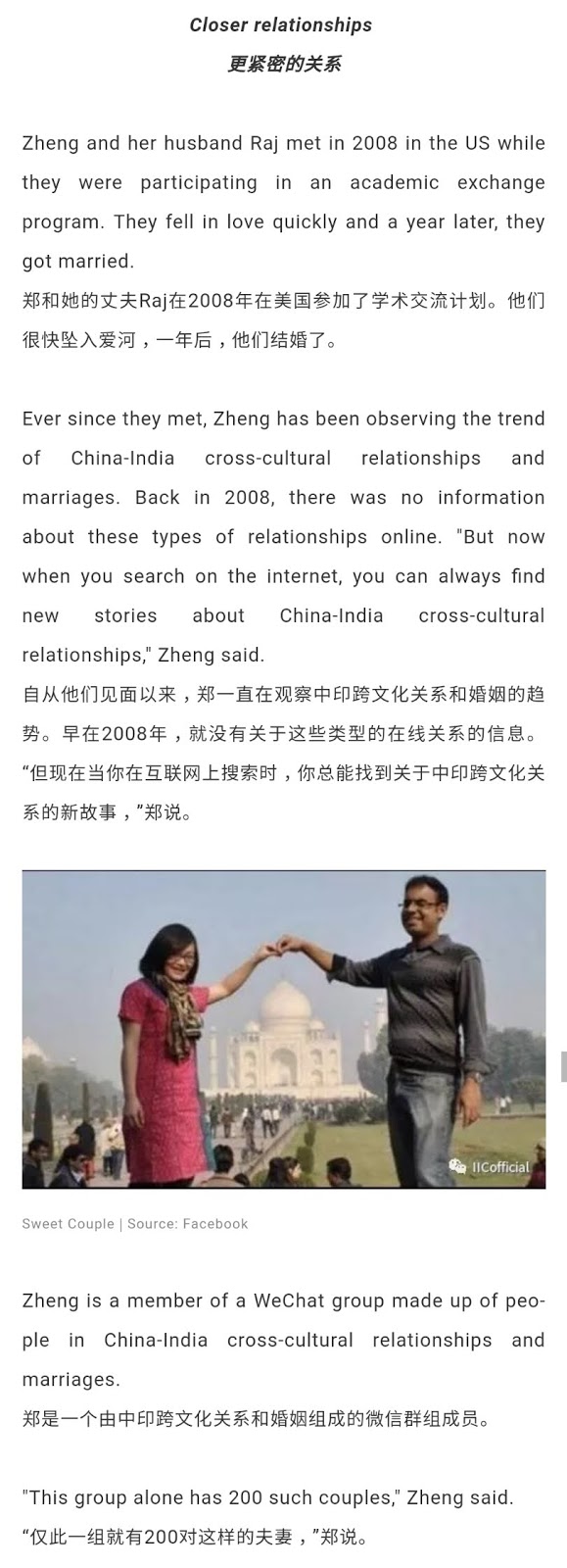
Zheng and her husband Raj met in 2008 in the US while they were participating in an academic exchange program. They fell in love quickly and a year later, they got married.

郑和她的丈夫Raj在2008年在美国参加了学术交流计划。他们很快坠入爱河,一年后,他们结婚了。

Ever since they met, Zheng has been observing the trend of China-India cross-cultural relationships and marriages. Back in 2008, there was no information about these types of relationships online. "But now when you search on the internet, you can always find new stories about China-India cross-cultural relationships," Zheng said.

自从他们见面以来,郑一直在观察中印跨文化关系和婚姻的趋势。早在2008年,就没有关于这些类型的在线关系的信息。 “但现在当你在互联网上搜索时,你总能找到关于中印跨文化关系的新故事,”郑说。

Zheng is a member of a WeChat group made up of people in China-India cross-cultural relationships and marriages.

郑是一个由中印跨文化关系和婚姻组成的微信群组成员。

"This group alone has 200 such couples," Zheng said.

“仅此一组就有200对这样的夫妻,”郑说。

Most of the relationships consist of an Indian man and a Chinese woman. According to Zheng, there is only one couple in the WeChat group where the woman is Indian and the man is Chinese. Most of the couples in the group live in China; a small percentage of them live in other more developed countries like the US.

大多数关系由印度男人和中国女人组成。据郑先生介绍,微信组中只有一对夫妇是印度人妻子,男人是中国人。这群人中的大多数夫妻都住在中国;其中一小部分人生活在美国等其他较发达的国家。

"This shows the inequality of men and women in India. Men have more opportunities to get an education, go into the world and be free to choose their own marriages. Not many women in India have these opportunities," she said.

“这显示了印度男女的不平等。男性有更多的机会接受教育,进入世界,可以自由选择自己的婚姻。印度没有多少女性有这些机会,”她说。

The increasing number of such couples indicates the more frequent exchanges between the two countries.

越来越多的这种夫妇表明两国之间的交流越来越频繁。

"More Indians are coming to cities in China like Guangzhou, Guangdong Province and Ningbo, Zhejiang Province to conduct business in trade. Once they are here, they meet the love of their life in China," Zheng said.

“越来越多的印度人来到中国的城市,如广州,广东省和宁波,浙江省开展贸易业务。一旦他们来到这里,他们就会遇到爱的人,”郑说。

Besides the business community, there is also more education exchange between China and India. From this education exchange process, more China-India cross-cultural relationships and marriages have emerged.

除了商业社区,中国和印度之间的教育交流也更多。从这种教育交流过程中,出现了更多的中印跨文化关系和婚姻。

According to a report by the People's Daily in January, there were 18,171 Indian students in China in 2016, which surpassed the number of Indian students in the UK, a country that has been very attractive to Indian students.

据“人民日报”1月报道,2016年中国有18,171名印度学生,超过了英国的印度学生人数,这个国家对印度学生非常有吸引力。

According to the same report, most Indian students choose to study medical science majors, engineering and computer sciences in China because of the lower cost and better job prospects.

根据同一份报告,由于成本较低,就业前景较好,大多数印度学生选择在中国学习医学专业,工程学和计算机科学。

According to a Global Times report in August 2017, the number of Chinese students in India has also increased in recent years. Chinese students are attracted by India's cost-effective higher-level education and English-language environment.

根据2017年8月的环球时报报道,近年来印度的中国学生人数也有所增加。印度具有成本效益的高等教育和英语环境吸引了中国学生。

Dheeraj is a 22-year-old medical student who currently studies at Peking University, and he met his Chinese girlfriend a year ago on campus.

Dheeraj是一名22岁的医学院学生,目前在北京大学学习,一年前他在校园里遇到了他的中国女友。

"Most Chinese girls are well educated, independent and have an open mind to people from other cultures. Besides that, their personality is very gentle, and they care about their family," Dheeraj said, adding that many of his Indian friends in China want to find a Chinese partner.

“大多数中国女孩都受过良好的教育,独立,对来自其他文化的人有开放的心态。除此之外,他们的性格非常温和,他们关心他们的家庭,”Dheeraj说,并补充说他在中国的许多印度朋友都想要找一个中国伴侣。

Besides the business and student community, many Chinese and Indians meet each other and fall in love in a third country while they are traveling or studying abroad like Zheng and her husband Raj did.

除了商业和学生社区之外,许多中国人和印度人在旅行或出国留学期间相遇并在第三国坠入爱河。

Yankee Chen, who runs a coffee shop in Beijing, met her Indian boyfriend in Malaysia while she was traveling with her friend.

在北京经营一家咖啡店的Yankee Chen在与她的朋友一起旅行时遇到了她在马来西亚的印度男友。

"I fell in love the first time I laid eyes on him, and we established a relationship the day after we met. Five years later, we are still together," Yankee Chen said. "Most of my friends don't understand why I insist on dating an Indian, whom they presume are uneducated, poor, unsanitary and have no respect for women. It's not easy."

“我第一次看到他时就坠入爱河,在我们见面后的第二天就建立了关系。五年后,我们还在一起,”Yankee Chen说。 “我的大多数朋友都不明白为什么我坚持与印度人约会,他们认为印度人没有受过教育,贫穷,不卫生,不尊重女性。这并不容易。”


Barriers to surmount 超越的障碍 


To Zheng and her husband Raj, their road together is a bumpy one, and they had to go through many obstacles to be together, mainly from their families.

对于郑和她的丈夫拉吉来说,他们的道路是一个颠簸的道路,他们必须经历许多障碍才能在一起,主要来自他们的家人。

When Zheng first announced to her parents that she was dating a guy from India and they were going to get married, her mother cried for an entire year.

当郑首次向她的父母说她正在和一个来自印度的男人谈恋爱准备要结婚,她的母亲哭了整整一年。

"They didn't even know where India was, and they just assumed that people from India are poor, could not provide a good life for me, are superstitious and abuse women," Zheng said.

“他们甚至不知道印度在哪里,他们只是觉得印度的人贫穷,无法为我提供好生活,迷信和虐待女性,”郑说。

"They came to those conclusions based on the pieces of information from the internet where the media only report extreme cases as a hype to attract audiences."

“他们根据来自互联网的信息得出了这些结论,媒体只报道极端情况作为吸引观众的炒作。” "My family threatened to disown me if I insisted on being with him," Zheng recalled.

“如果我坚持和他在一起,我的家人就会威胁和我断绝关系,”郑回忆说。

While Zheng was under pressure from her own parents, her boyfriend Raj was under even more pressure from his parents. Raj's mother also cried every day and worried about their relationship.

虽然郑女士受到了自己父母的压力,但她的男友拉吉则受到父母的压力。拉吉的母亲每天都哭着担心他们的关系。

Arranged marriage is still the ideal choice for most Indian families. The older generations still believe that only by arranged marriage can their children have a stable marriage and that free love is a bad thing, according to Zheng, especially since Raj is from a place that tends to be closed-up to foreign cultures, and Raj is the first person in his hometown to marry a foreign woman that he knows of.

对于大多数印度家庭来说,安排婚姻仍然是理想的选择。据郑说,老一辈人仍然认为只有通过安排婚姻才能使他们的孩子拥有稳定的婚姻,而自由恋爱是一件坏事,特别是像拉吉来自一个往往与外国文化封闭的地方,而拉吉他是家乡第一个娶了外国女人的人。

"Free love is frowned upon, not to mention finding a foreign woman, that's a catastrophe," Zheng said.

“自由的爱是不受欢迎的,更不用说寻找一个外国女人,这简直是一场灾难,”郑说。

This is due to the stereotypes the older generation has for foreign women, according to Zheng.

郑说,这是由于老一代对外国女性的刻板印象。

The literacy rate and the internet penetration rate are not high in that time, so their perception of the outside world is limited, according to Zheng.

郑说,印度的识字率和互联网普及率并不高,因此他们对外界的看法有限。

India went through a rather closed period, and the media created some stereotyped images of foreign women, like in the popular Indian movie Purab Aur Paschim (1970), the Western women in the movie are depicted behaving rather loosely and they trick the kind, pious Indian boys, according to Zheng.

印度经历了一个相当封闭的时期,媒体创造了一些外国女性的刻板印象,就像流行的印度电影Purab Aur Paschim(1970)一样,电影中的西方女性被描绘成表现得相当开放,他们欺骗那种善良,虔诚的印度男孩。

"Under those circumstances, it is no wonder that many older Indians are defensive about foreign women. The obstacles we went through are mainly because of the misunderstandings between people from the two countries," Zheng said.

“在这种情况下,难怪许多印度老年人对外国女性采取防御措施。我们遇到的障碍主要是因为两国人民之间的误解,”郑说。

Fortunately, their love for each other is determined. Zheng and Raj eloped in the US, where Raj was doing his doctorate degree. Later, due to the constant persuasion and the confirmation that they are nothing like the stereotyped images, their parents finally accepted their marriage.

幸运的是,他们对彼此的爱是决定的。郑和拉在美国私奔,Raj正在那里攻读博士学位。后来,由于不断的说服和确认他们不像陈规定型的形象,他们的父母终于接受了他们的婚姻。

The many similarities 有很多相似之处 

With nine years of marriage and two children, Zheng said despite the misunderstandings and the stereotyped images, people from China and India actually have a lot in common in terms of the relationship in a marriage and the strong attachment and feelings to their families.

郑女士说,在结婚九年和两个孩子的情况下,尽管存在误解和刻板印象,但中国和印度人在婚姻关系和对家庭的强烈依恋和感情方面确实有很多共同之处。

The family culture in China and India are both ones where the parents sacrifice everything to support and take care of their children, and the children take care of their parents when they are old, Zheng said.

郑说,中国和印度的家庭文化都是父母牺牲一切来支持和照顾子女的家庭文化,孩子们在他们年老时照顾父母。

Momo writes for her Mother-In-Law on Facebook:  
For the past 40 days, every morning my mother-in-law wakes up at 6am to cook for the whole family, then she feeds, changes diaper, plays with the kids. In the library events we attend almost everyday, she is always jumping, singing and dancing with the kids, full of interests and energy. 
Every night after we feed, shower, and make the kids sleep, my mother-in-law would clean up the whole kitchen and living space. Most of the time at 11pm you would find her folding the mountains of clothes of the family, almost dosing off.  
The day before she flying back to India, she was crying and telling me:"Momo I love you very much." Do you know, Maa, I cherish each every minute of the quality time we spent with you.  
Because you show me what is the true meaning of selfless love. In this selfish world, we see people getting dragged into their little world, we see them getting smaller and smaller. They fight over small personal lost and gain, while you are breaking your back, quietly washing the millions of dishes, packing the zilliions of toys, mopping the floor of the whole house. 
You are still capable of giving, giving your whole heart. 
You are still capable of sacrificing, sacrificing without caring about the rewards. 
You are still ashamed of taking, no matter how tough of the life you had lived. 
You still respect each every being you encoutered, forgives each every wrong doing and you teach us to do the same.  
You are stronger than most of the people I've known. Because the ability of respect and forgive, the ability to achieve real inner peace, only happens with really strong minds.  
Every day I am feeling unbelievably lucky for my kids, because my mother has the exact same quality as my mother-in-law. 
I wish my kids will grow up to cherish their grandmothers, and to be like their grandmothers 


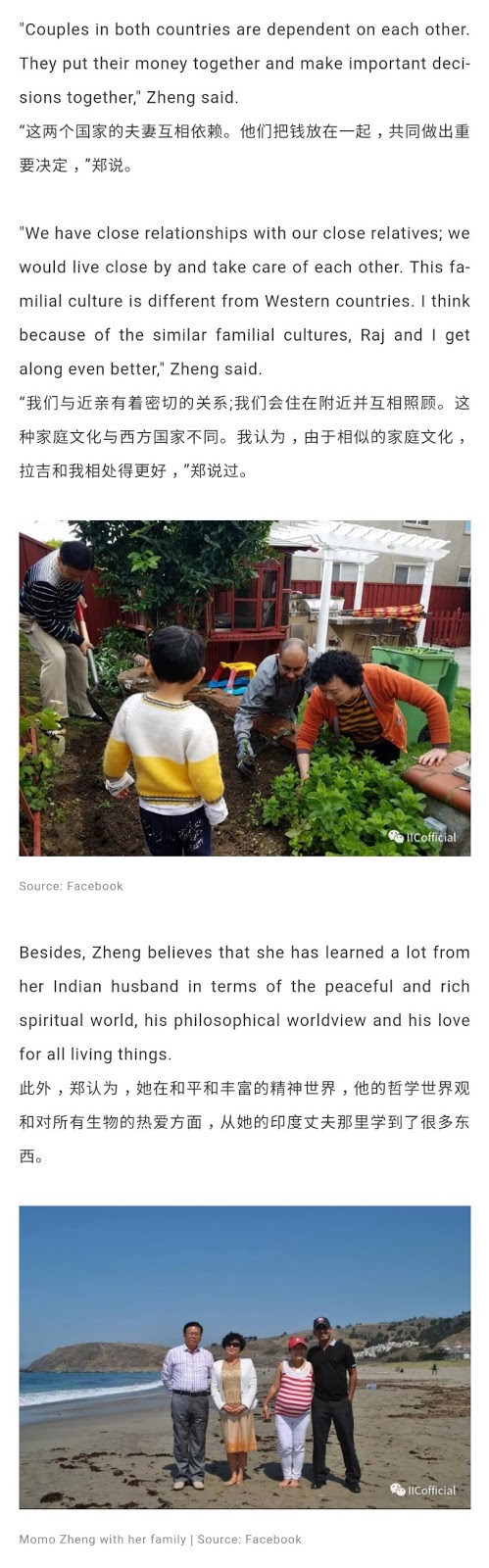
"Couples in both countries are dependent on each other. They put their money together and make important decisions together," Zheng said.

“这两个国家的夫妻互相依赖。他们把钱放在一起,共同做出重要决定,”郑说。

"We have close relationships with our close relatives; we would live close by and take care of each other. This familial culture is different from Western countries. I think because of the similar familial cultures, Raj and I get along even better," Zheng said.

“我们与近亲有着密切的关系;我们会住在附近并互相照顾。这种家庭文化与西方国家不同。我认为,由于相似的家庭文化,拉吉和我相处得更好,”郑说过。

Besides, Zheng believes that she has learned a lot from her Indian husband in terms of the peaceful and rich spiritual world, his philosophical worldview and his love for all living things.

此外,郑认为,她在和平和丰富的精神世界,他的哲学世界观和对所有生物的热爱方面,从她的印度丈夫那里学到了很多东西。

"I believe that with the more frequent exchanges between the two countries, people from China and India will get deeper, and we will see more cross-cultural relationships and marriages between the two countries," Zheng said.

“我相信,随着两国交流的频繁发展,来自中国和印度的人们将会更加深入,我们将看到两国之间更多的跨文化关系和婚姻,”郑说。

环球时报:中印通婚数量增加 - 视频报道 Global Times video reporting on Chinese-Indian cross-cultural marriage


@环球时报英文北京版:【中印通婚数量增加[喜]】近年来,中印经济文化交往密切,来中国经商和求学的印度人增多,中印通婚的数量也随之增加。中印恋人都会遇到很多障碍,主要源于民众对对方国家的不理解。比如很多中国人都认为印度人都很穷,还虐待女性。印度人认为外国女性太开放,但是中印的家庭文化有很多相似之处,夫妻关系紧密,都很以家庭为中心。


Global Times: Chinese-Indian cross-cultural couples face family and cultural road blocks when fighting for their own happiness

http://www.globaltimes.cn/content/1092031.shtml
By Zhang Xinyuan Source:Global Times Published: 2018/3/6 18:23:40


Growing up, Zheng Momo from Guangze county, Fujian Province never imagined that she would marry a man from India, a nation that is geographically close China but still remains a mystery to most of China's population.

She and Raj Shekhar Singh, from Bokaro in India, have been married for 9 years, and live in the US. "What attracts me to him is his rich spiritual world, his respect for women and his mercy to people and animals," Zheng said.

"We went through a lot of barriers to be with each other like most other people in China-India cross-cultural relationships. We really cherish what we have today."

The number of China-India cross-cultural relationships and marriages has increased in recent years because of the more frequent economic and cultural exchanges between the two countries, according to Zheng's observations.

Hu Zhiyong, a research fellow at the Institute of International Relations of the Shanghai Academy of Social Sciences, also observed the same trend. "

As the internationalization got deeper and the economic and trade relationships between China and Southeast Asian countries develop, China-India cross-cultural relationships and marriages will increase," Hu said.

"Under the influence of the Belt and Road initiative, more Chinese are visiting and working in Southeast Asian countries. It also provides opportunities for Indians and Chinese to learn about each other," Hu said.

Closer relationships

Zheng and her husband Raj met in 2008 in the US while they were participating in an academic exchange program. They fell in love quickly and a year later, they got married.

Ever since they met, Zheng has been observing the trend of China-India cross-cultural relationships and marriages. Back in 2008, there was no information about these types of relationships online. "But now when you search on the internet, you can always find new stories about China-India cross-cultural relationships," Zheng said.

Zheng is a member of a WeChat group made up of people in China-India cross-cultural relationships and marriages.

"This group alone has 200 such couples," Zheng said.

Most of the relationships consist of an Indian man and a Chinese woman. According to Zheng, there is only one couple in the WeChat group where the woman is Indian and the man is Chinese. Most of the couples in the group live in China; a small percentage of them live in other more developed countries like the US.

"This shows the inequality of men and women in India. Men have more opportunities to get an education, go into the world and be free to choose their own marriages. Not many women in India have these opportunities," she said.

The increasing number of such couples indicates the more frequent exchanges between the two countries.

"More Indians are coming to cities in China like Guangzhou, Guangdong Province and Ningbo, Zhejiang Province to conduct business in trade. Once they are here, they meet the love of their life in China," Zheng said.

Besides the business community, there is also more education exchange between China and India. From this education exchange process, more China-India cross-cultural relationships and marriages have emerged.

According to a report by the People's Daily in January, there were 18,171 Indian students in China in 2016, which surpassed the number of Indian students in the UK, a country that has been very attractive to Indian students. According to the same report, most Indian students choose to study medical science majors, engineering and computer sciences in China because of the lower cost and better job prospects.

According to a Global Times report in August 2017, the number of Chinese students in India has also increased in recent years. Chinese students are attracted by India's cost-effective higher-level education and English-language environment.

Dheeraj is a 22-year-old medical student who currently studies at Peking University, and he met his Chinese girlfriend a year ago on campus.

"Most Chinese girls are well educated, independent and have an open mind to people from other cultures. Besides that, their personality is very gentle, and they care about their family," Dheeraj said, adding that many of his Indian friends in China want to find a Chinese partner.

Besides the business and student community, many Chinese and Indians meet each other and fall in love in a third country while they are traveling or studying abroad like Zheng and her husband Raj did.

Yankee Chen, who runs a coffee shop in Beijing, met her Indian boyfriend in Malaysia while she was traveling with her friend.

"I fell in love the first time I laid eyes on him, and we established a relationship the day after we met. Five years later, we are still together," Yankee Chen said. "Most of my friends don't understand why I insist on dating an Indian, whom they presume are uneducated, poor, unsanitary and have no respect for women. It's not easy."

Barriers to surmount 

To Zheng and her husband Raj, their road together is a bumpy one, and they had to go through many obstacles to be together, mainly from their families.

When Zheng first announced to her parents that she was dating a guy from India and they were going to get married, her mother cried for an entire year.

"They didn't even know where India was, and they just assumed that people from India are poor, could not provide a good life for me, are superstitious and abuse women," Zheng said.

"They came to those conclusions based on the pieces of information from the internet where the media only report extreme cases as a hype to attract audiences."

"My family threatened to disown me if I insisted on being with him," Zheng recalled.

While Zheng was under pressure from her own parents, her boyfriend Raj was under even more pressure from his parents. Raj's mother also cried every day and worried about their relationship.

Arranged marriage is still the ideal choice for most Indian families. The older generations still believe that only by arranged marriage can their children have a stable marriage and that free love is a bad thing, according to Zheng, especially since Raj is from a place that tends to be closed-up to foreign cultures, and Raj is the first person in his hometown to marry a foreign woman that he knows of.

"Free love is frowned upon, not to mention finding a foreign woman, that's a catastrophe," Zheng said.

This is due to the stereotypes the older generation has for foreign women, according to Zheng.

The literacy rate and the internet penetration rate are not high in India, so their perception of the outside world is limited, according to Zheng.

India went through a rather closed period, and the media created some stereotyped images of foreign women, like in the popular Indian movie Purab Aur Paschim (1970), the Western women in the movie are depicted behaving rather loosely and they trick the kind, pious Indian boys, according to Zheng.

"Under those circumstances, it is no wonder that many older Indians are defensive about foreign women. The obstacles we went through are mainly because of the misunderstandings between people from the two countries," Zheng said.

Fortunately, their love for each other is determined. Zheng and Raj eloped in the US, where Raj was doing his doctorate degree. Later, due to the constant persuasion and the confirmation that they are nothing like the stereotyped images, their parents finally accepted their marriage.

The many similarities

With nine years of marriage and two children, Zheng said despite the misunderstandings and the stereotyped images, people from China and India actually have a lot in common in terms of the relationship in a marriage and the strong attachment and feelings to their families.

The family culture in China and India are both ones where the parents sacrifice everything to support and take care of their children, and the children take care of their parents when they are old, Zheng said.

"Couples in both countries are dependent on each other. They put their money together and make important decisions together," Zheng said.

"We have close relationships with our close relatives; we would live close by and take care of each other. This familial culture is different from Western countries. I think because of the similar familial cultures, Raj and I get along even better," Zheng said.

Besides, Zheng believes that she has learned a lot from her Indian husband in terms of the peaceful and rich spiritual world, his philosophical worldview and his love for all living things.

"I believe that with the more frequent exchanges between the two countries, people from China and India will get deeper, and we will see more cross-cultural relationships and marriages between the two countries," Zheng said.


Newspaper headline: Penetrating preconceptions

Posted in: METRO BEIJING


Tuesday, April 17, 2018

北京媳妇在印度--百度印度吧吧主事件存档

因为有对具体事件前后详细追踪的调查新闻癖,于是把整个事件从我个人的视角记录下来,不发在国内因为早已在心里翻页,不想继续引起争端。只是存个档,做为给自己的一个交代。

**在微博上指出“北京媳妇在印度”即为当年百度印度吧吧主


**“北京媳妇在印度”主动承认


**引起中印恋姐妹圈不小唏嘘,很多姐妹之前都因此承受过痛苦,以下是一些跟进的回应,大部分人反应账号被她拉黑,我也收到她发来的威胁


**4月13日

在知乎发但帖子被他们恶性举报,结果真的被知乎隐藏起来,于是便罢了没有再做跟进。以下是知乎事件截图和被删原文


这个女孩早在06、07年开始就以BJcutie这个名字出没在百度印度吧,因为她是做从印度进口纱丽到中国卖的生意的。当年的百度印度吧完全就是乌烟瘴气,全是一边倒的恒河浮尸和几百印度人爬火车的类似帖子和照片。当时常年置顶百度印度吧的是她写的"忠告中国女孩千万不能嫁到印度"的帖子,阅读量极大,内容危言耸听,说"印度男人会满街追着摸女人","没有印度男人不打老婆","印度小孩都是小流氓、婆家都是大流氓"。

09年我找了印度男友后去网上搜索有关印度的资料,看到的都是源自于百度印度吧的此类言论。告诉父母后,他们和亲戚也上网搜,很长一段时间都因为这些不实信息撕心裂肺、彻夜不眠。我的家人因为我的选择以及中国网络上印度的言论受到了极大的伤害。但在家人的反对声中我和印度男友最终还是私奔走到了一起,过了多年之后父母才不得不同意。

因为受到偏颇言论不小的影响,那时的我也试着在百度印度吧发一些比较中肯的言论,比如传达"我的印度男友很正直"这样的讯息。但是做为百度印度吧吧主的BJcutie,也就是现在的北京媳妇,一手遮天,任何一点关于印度的非负面信息一律被删除干净,连着帐号一起被封。不止是我的遭遇,2006至2013年间交往过印度男友并与百度印度吧打过交道的中国女孩都遭到了在吧里被集体辱骂、删贴、封号的命运。

今天来知乎发帖是因为看到楼主告诫年轻女孩不要相信她的,认为嫁去印度是美好童话。其实她的微博我没有那么仔细地研究,看了楼主的帖子才明白她的深意。我自己是嫁到印度的女孩没错,但是印度的嫁妆制度和印度女性社会地位真的是和中国差了太多。这么多年看过来,全世界范围内中国女性的社会地位是非常靠前的,不可否认,我自己大大受益。

我经常有写一些关于印度女性地位、嫁妆制度、包办婚姻之类的文章。特贴于此,希望女孩们谨慎小心。我觉得印度是个充满复杂性的社会,重精神重文化,在其社会可以看到最先进与最古老、最圣洁与最龌龊、最高尚与最低俗、最精神与最物质等种种矛盾并存,而且有时肩并着肩存在,无论是个体还是集团,都具有非常大的特性、独特性。所以真的不能一概而论,更不能因为利益的驱使不负责任地去盲目引导和教唆不知者。

----
我看印度女性地位
2018年4月5日
今早印度奶奶发现快没有白糖了,因为我们平时是在Costco买大包的,所以不急着到家附近的零售店买新的,想等有机会去Costco再说。对于每天喝无数杯不成比例地加三四把糖的红茶的印度奶奶来讲,这可是个不小的危机,要是今晚仅剩的一点糖都吃完了怎么办?但是她心态很好,立马就能开出玩笑来:“没事没事,仅剩的一点白糖给宝贝们喝牛奶用,奶奶和妈妈(只配)用不好的糖,坏糖归奶奶和妈妈专属。”这“坏糖”指的是印度人做甜品用的没有加工过的原糖,像石头一样一大块,我反而觉得没漂白过的更纯更天然。

印度奶奶经常会在不经意间流露出这种语气,似乎孩子们就应该理所当然获得最好的,有什么不好吃的就应该归母亲吃。她对我的孩子是这种态度还无所谓,在我和我孩子面前对她自己已成年的儿子有这种态度,我心里就会暗自不爽。这不爽也是这么多年看得多了累积下来的。

我婆婆对公公尊称了一辈子的“您”,公公对婆婆贱称了一辈子的“你”,即便我公公在家底、学历、脾气、心态、涵养等各方面都差我婆婆不少,还完全没有做生意的头脑,一辈子基本上没有带家人摆脱贫困的底层生活,最终还在2009年至2013年间因管理不善和通货膨胀亏了将近一百万人民币这么一大笔。硬是那几年还没有过门的我和靠读书来美国的Raj把辛辛苦苦赚来的美元一笔一笔地打过去救济,家才没有破,到现在都还在慢慢帮着还。就这样我公公却经常因为一点小事比如我婆婆对一些事情有自己的看法,稍微评论了两句,就对她大发雷霆,很难听的话都骂得出来,说什么“你傻逼女人傻了一辈子,叫你不要插话你就给我闭嘴,这些事是你傻逼女人管的吗?”

几次在印度家住的时候我都听得一惊一乍的。我婆婆总是默不作声地躲在一边,息事宁人,一副被骂了一辈子骂惯了的感觉。她还常教育我要以和为贵,夫妻间吵架是常事,但是不能太经常吵、吵太凶了,会影响到孩子们的健康心理。这些是对的道理没错,但是我看公公和婆婆根本不是吵架,而每次都是公公单方面的炸锅和训斥,婆婆总是以“你公公年轻的时候受了大伤后走路瘸了脾气也变坏了”、“你公公是为了这个家,他心是很好很顾家的”种种理由为他推脱。也是为了孩子们的心理和教育,这一辈子过来我婆婆都在暗自承受。

我婆婆脑子里对吃这件事情也有个大坑,我总感觉她认为她自己多吃就等同于贪婪,等同于精神不强大意志不坚定,看到与她同等身份的女人多吃了也会有一定排斥感。后来我看到了这个坑是印度社会女 人的通病,因为在资源稀缺的社会里,集体生活中最先被剥夺与压迫的是女人,不分年龄,从幼童到老妇。吃的不够的话,“没用”的女人理所当然要少吃,等家里的顶梁柱男人和未来的顶梁柱儿子都吃饱了,才轮到女人吃点剩的,这是女人应该要有的妇德。

在印度家里住的时候,公公和成年的孩子们集体坐好,没事人儿一样集体聊着天。“妈,饭端上来!” 于是动作很慢的婆婆就一盘一盘地把他们每个人的饭菜舀好,送到跟前桌子上。“妈,给我打杯水来!” 于是婆婆又放下盘子找到杯子打杯水来放到面前。“咦,怎么没有腌菜?你们妈妈动作真慢呐!” “妈动作慢了一辈子了哈哈!”于是婆婆又放下勺子找到腌菜去打一小盘来。等全家人都吃饱喝足了,婆婆把盘子都收进厨房了,自己才站着靠着随便吃一点,那时饭菜已经都完全凉掉了。所以我婆婆早已习惯了吃冷的饭菜,在我们家用微波炉热菜常常半冷不热就端给我孩子们吃。幸好公公婆婆家里养了两个女儿,而且他们都是极善良的人,他们对我这个儿媳妇也还真是当女儿对待,从来没有使唤过我一次,我要帮忙也总是被劝停。

所以我一听到婆婆对公公毕恭毕敬地喊着:“您好啊您好啊,今天您吃了什么啊?今天您身体还舒服吗?”心里就非常不爽。我一看到Raj明明自己闲着没事,还要让忙着做饭的母亲给希娃端杯水就立马狠抽他。他对他母亲使唤惯了是从小从他父亲那里耳濡目染传下来的,一时半会儿真改不掉,但他明白我和他之间除了平等只有平等,唯有这样才能维系住感情。不过我还是会动不动用各种方式提醒他,“我不是你母亲啊,你可别不小心随便使唤我,在孩子们面前树立负面形象,以防孩子们以后被他们朋友嘲笑!”

印度还是个非常传统的社会,其社会的经济构架还没有完成现代化的转型,加上以社会司职来划分的种姓制度在不同的统治时期都被刻意固化了,不少旧有的工业和社会分工在当地依然很兴旺。在旧的经济构架下,无一例外的都是男主外女主内,祖上传下的家业必定是靠男人的血脉,爷爷传爸爸传儿子,女人只在家庭结构中起着服侍全家和传宗接代的作用,经济上依附于男人,拿人家的手短,生活也就没有独立性。相比而言,现代化的经济构架从对人肌肉的要求转变成了对头脑的要求,不管男女,只要接受过好的教育,就可以胜任同样的职业,因为男女在身体强度方面差很多,却在智商上均等。一旦女性参与到社会性的增值中,经济上的独立便是女性建立起独立人格,建立起与男性平等的社会结构的钥匙。

其实从全球范围来看,整个人类都经历过或在经历着从父系氏族慢慢向男女平等转型的过程,只不过有的地方快些,有的地方慢些。过去几百年完成了工业革命,经济完成了向现代化转型,没有受过侵略的欧洲就最快。欧洲女人闹了两百多年,从最开始烧胸衣烧裙子,到争取工作权争取选举权,现在还是要不停地提不断地在改进和完善。比如现在西方女权界讨论的话题是类似于“孩子的图画书为什么男主人公的多?给女孩子看的书呢?凭什么女孩子就只能做公主不能当科学家?”“为什么给女人做的裤子就没有口袋或者口袋那么小,怎么装智能手机?凭什么男人就可以有大大的裤子口袋女人就不可以?”这样的话题。而过去几百年完全失去了自我演进的权利却被殖民被剥削、刚刚才独立了几十年社会依然在整合、工业化现代化也步子较慢的印度,女权的发展自然就落后别人一大截。

那有朋友问,为什么中国在民国的时候女人还裹着小脚,不到一百年之后情况就出现了这么大的改观?我觉得这个要归根于中国文化的统一性,导致整个社会的任何改变都可以达到迅雷不及掩耳之速,直接原因是西方文化的滲入、删除传统的运动、“女人半边天”和计划生育,这里面坑太大,就不赘述了。我觉得只要不把现有的良好状态当成理所当然,而是认真地去珍惜,明白我们仍然要不断地去争取去完善,绝对不能走回头路,这就够了。

做为两个孩子的母亲,脑子里考虑的所有事情最后都会做为怎样教育孩子的参考,我也曾一度陷入了以怎样的姿态做母亲的矛盾中。以前我曾认为是因为东方社会传统价值观里母亲心甘情愿的牺牲,才成就了孩子的无私之心。但是在印度这个如此重宗教,如此讲究精神追求的地方,为什么在个体家庭中存在着那么多的不公与暴力?这显露出的人性的贪婪与自私,似乎与其社会的宗教性格格不入。后来我明白了,正是因为印度社会女性地位依然低下,孩子在人生最初的家庭教育里学到的是建立在性别上的不公正与对女性亲人各项权利理所当然的剥夺,这样长大的孩子,怎么可能无私呢?所以我认为要想培养出心灵美好的孩子,绝对不能单方面要求母亲做没有底线的牺牲,而是在母亲与父亲地位平等的前提下,两方父母都能做出取舍和牺牲,这样才会给孩子树立起正确的价值观。

这几天看微博上对印度的种姓制度津津乐道,我认为种姓已经是马上就要被翻过去的历史一页,印度社会发展进步的真正桎梏,是占这个社会一半的人力资源被随意践踏、任意剥削,无法释放出在现代经济构架下该有的能量。印度社会女性地位一日得不到提高,其社会各项发展也会成为泡影。而一旦其女性的能量通过教育和政府、社会团体的扶持得到释放,会给社会各方面增添很大的活力。社会总是在进步的,因为在历史的战火和硝烟中,平等和自由是永恒不变的人类之歌。共勉。

-----
3月5日微博
前几天有个中国女孩找我聊天说她处了一年的印度男友花她的钱买了很多东西带回印度后与家庭包办的印度女孩闪婚了,男孩之前还挺实在地告诉过她按他这种家庭和学历,随便在印度找个女方家都要给至少100万人民币的嫁妆。我对她说:"哇,你这是破财消灾啊,阿弥陀佛,还好他是印度人无法轻易和你结婚。不然被骗婚后你逃都逃不出来,苦一辈子,就像他新婚妻子的悲惨命运,可怜了她完全无自主权,被迫嫁入这样的家庭!" 我觉得谈恋爱阶段就会向女人要钱的男人不管是哪国人,嘴巴一张第二天就要打包行李跑路,等到他拿"自己和别的女人结婚就会拿到100万"这种话来给你施压的时候都已经太晚了。

大家看我的家庭还算是比较幸福,那是因为碰到了正直的印度人,Raj他有责任感道德感,善良热心,父母也是正直得一塌糊涂,这是我当初在一起的时候所追求的---一颗金子一样的心。从这么多年的观察来看,不是所有人都这样,反而是各种陷阱重重,花言巧语的烟雾弹很多。所以想请在和印度人接触的中国姐妹们一定要多个心眼,要多对他进行各方面的考量和审视。毕竟以后要经历很多充满牺牲与坎坷的异国恋,一定要保证他的人品够正派,心灵纯真到可以让你放逐自己。

之前就写过这些话,下面把《中印恋人如何说服印度方父母》里面的一些话单独摘出来,给姐妹们提个醒:

"在印度有很大一部分婚嫁依然还是父母包办。传统的包办婚姻就像是双方家长在做生意,女方家长以女为贱,不仅要把辛苦养大的人交过去为男家生男娃传宗接代,为他们全家做饭洗衣端茶倒水,省去了男方家里雇小工的钱,女方家里还要为此支付一大笔嫁妆。嫁妆数目多大,怎么个支付法,在婚前两方家庭都要商榷好,达不成协议婚也结不成。男方家里吹眉瞪眼为了多拿几千卢比的例子举不胜举。所以很多男孩子家里坚决不同意儿子自由恋爱,其实说白了是为了赚这一笔嫁妆钱。男孩越是学历高家里能开到的价格就越高,比如像Raj这样印度理工学院的毕业生,愿意支付上百万人民币现金做嫁妆的女方家长排长队等着接亲。

这是碰到了贪婪邪恶的婆家。有可能出现在教育水平低的印度人家里,也有可能在公婆都接受过高等教育的家里,有可能是低种姓家庭,也有可能是高种姓家庭,和家庭的贫富也没有关系。这样的家庭在印度不算少数,如果不幸碰到了,不管男孩再帅嘴巴再甜学历再高,记住要停下来重新审视一番。因为嫁印度男人不单单是嫁给他,还嫁给了他的全家老小。如果男孩子的确人品正直,宽容慷慨,有自己做主的魄力,还可以考虑继续。如果男孩子经常对父母的无理要求妥协,即便是冲破阻力完婚,婚后其父母有可能因为当初损失了一大笔嫁妆收入而耿耿于怀,挑拨儿子与媳妇的夫妻关系,鸡犬不宁。印度每年因为婆家怀恨于嫁妆不厚而烧死儿媳的案子接连不断。我想女方支付嫁妆这个恶俗一日不改,印度女性对平等权益的诉求就枷锁难脱。
...

前几天听我婆婆讲她学校里一个女老师,儿子已经在德里自由恋爱找了老婆,生活在一起育有两个女儿。这个女老师和老公却执意隐瞒情况,骗了个包办的儿媳妇来,收了人家家里丰厚的嫁妆,逼儿子回来与这个包办的儿媳妇完婚。儿子回来把婚结了,儿媳妇生了个孙子,现在儿子又回到德里去和自己选的老婆住了。这个女老师把骗来的儿媳妇反锁在家里,不让她出门,不给零用钱,家里的食物每天做好记号怕她乱吃,自己天天提着家里的钥匙和厚厚的钱袋子去学校上课。我听得一惊一乍的,但婆婆说她见过的类似例子不少,因为女性地位一直低下,政府思维古旧、执法不利,明明知道这种行为触犯了各种法律,许多人依然大胆地下手。我们还讨论说,虽说女老师和她老公行为卑劣,他们的儿子也是个恶人,为什么要同意父母的决定回来成婚呢,他如果执意不肯,留在德里,他的父母又能拿他怎么样呢?女方家里没有看到新郎,怎么可能会同意成婚呢?这宗罪,是父母、儿子,他们全家人联手犯下的。"


(请原谅当时年轻的我竖中指这种"艺术行为",但当时的百度印度吧快照现在看来着实珍贵,算是中国网络上因为百度印度吧一手遮天而使公众对印度一无所知、言论一边倒的一段历史的记录吧。感谢现在多种媒体的兴起,微博、知乎、微信等等,网络上有了更多不同角度不同立场的报道,使我们对邻国印度渐渐有了更多客观的了解和认知,产生了更多有意义的讨论与争议。)

 ------------

 2018年4月10日添加 

很感谢大家中肯的评论,感觉知乎上的水平不愧是高。正是因为大家的平和,带动着我也静下心来反思和思考。 没错大家发现了我的博客截图内容其实是带着戾气的,在微博上我有提到因为心境的改变,自己几年前就把这些比较负气的博文悄悄隐藏起来了,因为不希望把这种负面情绪传达给网友。大家仔细看可以看到文章标题左上角的小锁。之前在知乎上忘记告知了。

是这样的,很多自己几年前发的感想,现在已经完全看不下去,觉得那时实在是非常偏颇和偏激。那时偶尔也会去拉黑一些来评论的网友,现在想来非常幼稚,自己不待见的行为自己却在做。几年前开始就对自己定下规矩,不管别人怎么评论,不许拉黑任何人,希望在自己这里可以看到两边的讨论甚至争论。 回想起来,自己当时的心态应该和那几年现实生活中没有得到双方家长认同有关,心态不平和就觉得什么听起来都刺耳,谁都是敌人。很感激生活的善待,也是因为自己和印度先生的不放弃,最终圆满完成中国和印度的婚礼,心境好了很多,自然也平和了下来。

 另外还有一条线是对印度的认知的加深。从最开始的"距离产生美"的对一个社会精神性的盲目崇拜,到后来每一次游走印度的一点一点更多的了解和体会,特别是在深入接触印度女性社会地位这个话题之后,到现在不禁推翻了自己"物质可能不一定是上层建筑的基础?"的疑问。 人的认知肯定是在不断加深和完善的,现在我无法直视十年前的想法和言论,说不定十年后的自己对现在的一些想法也是无法直视。我觉得能做到以坦然的心态,诚实地面对自己,保证此时此刻说的话都无愧于事实和内心就够了。

经常有对过去进行反思,并且分享出来给网友。并没有完全把过去隐藏,也不怕被别人看到,反而觉得自己心态的这样一个转变过程是蛮宝贵的一种记录,大背景除了自身故事的发展,更是网络的开放度在提高、人们对印度的兴趣在提高、人们对更加全面客观的印度认知的热情在提高。

 谢谢大家的关注,也衷心感谢大家的指正。共勉。